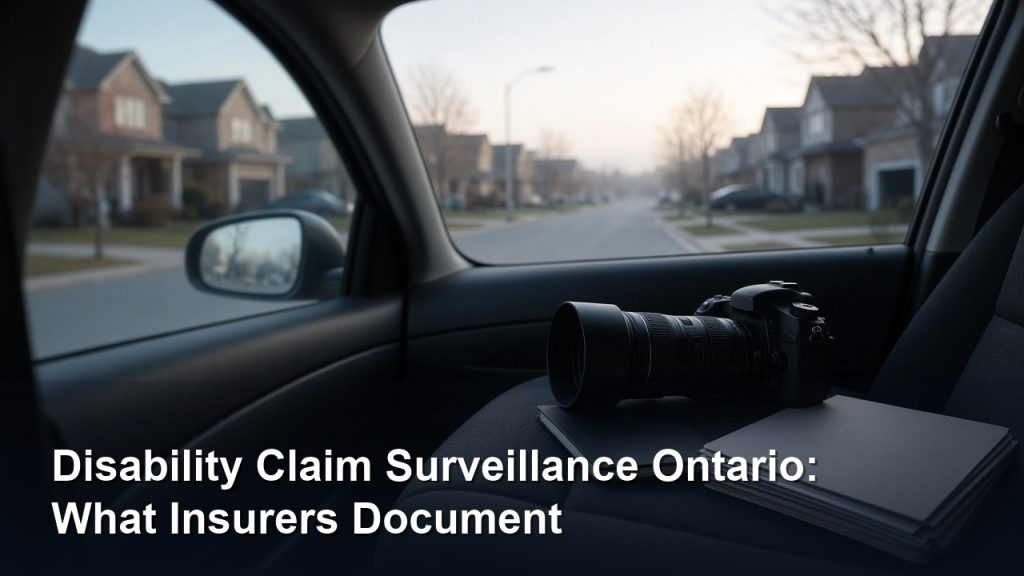
Disability claim surveillance in Ontario is not about catching someone on a “gotcha” afternoon. It is structured observation that tests whether day-to-day activity matches the limitations claimed on an STD, LTD, WSIB, or related disability file. Done lawfully, it produces timed logs, photographs or video from public vantage points, and a report insurers and counsel can actually use. Done poorly, it wastes money, harasses a claimant, or creates evidence that collapses under cross-examination.
This guide is for claims handlers, employers, and counsel who need to understand what licensed investigators can document, how days are scoped, and what a claim-ready package looks like. It is general information, not legal or medical advice. Policy wording and statute decide entitlement. Investigators document activity.
What disability claim surveillance is for
Surveillance answers a narrow question: during the windows you authorize, what did the subject do that is material to the claimed restrictions? Typical objectives include documenting lifting, carrying, prolonged standing or walking, driving, sports, renovation work, or employment inconsistent with total disability. The product is not a diagnosis. Investigators do not opine on medical truth. They record what was seen, for how long, with whom, and under what conditions.
That distinction matters in Ontario. Amateur medical conclusions in a PI report invite attack. Clean chronologies tied to claimed limits travel better through adjusters, IMEs, and hearings.
STD, LTD, WSIB, and related files
Methods overlap; the payor and legal frame do not. Short-term and long-term disability policies turn on own-occupation versus any-occupation definitions, waiting periods, and medical evidence. WSIB files involve workplace injury frameworks and different documentation needs. Private disability and casualty overlays can sit beside employment issues. Say at intake which regime you are in so investigators brief to the right activity questions.
Our disability claims investigation service is scoped for LTD/STD-style activity testing. Adjacent needs may map to WSIB investigations or broader insurance investigations. Physical observation usually sits on the surveillance foundation.
When surveillance is the right tool
Surveillance earns its cost when:
- Specific claimed limits can be tested by observing ordinary activity (lifting, range of motion in public tasks, stamina).
- Travel, sports, cash work, or renovations appear inconsistent with the claimed condition.
- An Independent Medical Examination is approaching and current activity would help the examiner’s context without turning investigators into clinicians.
- Address or occupancy questions affect claim administration and need field confirmation.
- Open-source clues exist but need corroboration in the real world.
Surveillance is weaker when the dispute is purely medical interpretation, paper-only income calculation, or a one-day anecdote with no pattern. A good agency will say so before you buy hours.
What licensed investigators can lawfully do
Ontario private investigators work under the Private Security and Investigative Services Act (PSISA) and must respect Criminal Code limits on voyeurism, harassment, and related offences. They may observe from public space, follow subjects on public roads, photograph from lawful positions, and log vehicles, addresses, and associates when identification is possible. They do not enter dwellings, hide in private yards, bait claimants into activity, or obtain private medical records without lawful process.
If GPS tracking is proposed for a vehicle, ownership and authority must be clear first. Many disability files are better served by planned physical surveillance than by gadgets that create legal risk. Ask what will be refused as well as what will be done.
How a surveillance day is planned
Intake should produce a written hypothesis: which claimed limits matter, which times of day are productive, and what would count as material activity. Investigators need current photos, vehicles, addresses, and any known gym, job site, or caregiver schedule. Days are chosen for likelihood, not random harassment. Multi-day patterns beat a single inconclusive afternoon.
GTA files often need more than one investigator when subjects move between municipalities or use highway corridors. Quote structure should show planning time, field hours, mileage, and reporting so you are not surprised mid-file.
Identification and honesty in the report
Claim-ready work starts with identification protocol. If investigators cannot identify the person, they do not invent certainty. Lighting, distance, masks, and lookalikes create limits that belong in the notes. Video and stills need date/time integrity. Summaries should separate observed fact from inference.
Reports that read like advocacy (“clearly faking”) weaken credibility. Reports that say “subject carried two bags of soil from vehicle to backyard over 18 minutes” give adjusters and counsel something usable.
What “inconsistent activity” usually looks like
Material inconsistency is file-specific. Examples that often matter, when tied to claimed restrictions:
- Repeated heavy lifting, digging, or renovation work after claims of severe lifting limits.
- Long drives, courier-style routes, or cash-job patterns after claims of inability to work.
- Sports, gym sessions, or recreational activity at intensity that contradicts sworn limits, described as activity, not as a medical verdict.
- Household or childcare patterns that show stamina inconsistent with total disability claims, where those claims are in issue.
One grocery trip does not destroy a claim. Patterns across windows do more work than drama.
Social media and open-source checks
Public posts sometimes show travel, sports, or work inconsistent with claimed limits. Licensed investigators can compile public material when authorized, often through social media investigations. Private accounts, hacking, and pretext for login credentials are off limits.
Screenshots without URLs, dates, and capture notes age poorly. Treat OSINT as leads that may justify field days, not as a complete substitute for observation.
Working with insurers, employers, and counsel
Instructions should come from someone with standing on the file. Employers coordinating disability absence need HR and legal alignment before surveillance is authorized. Insurers need claim numbers, alleged restrictions, and deadlines. Counsel should be looped in when litigation or WSIB appeals are active so field phases finish before affidavits or hearings lock.
Investigators gather facts. Decision-makers apply policy and law. A joint consult often prevents surveillance that looks dramatic but does not answer the contractual question.
What a claim-ready package usually includes
- Dated surveillance logs with locations and durations.
- Photographs or video from lawful positions with identification notes.
- Vehicle and associate identifiers when known.
- A chronology tied to the claimed limitations under review.
- A written summary that avoids amateur medical opinions.
- Clear statements of what was not seen (gap analysis).
Ask for sample redacted pages if you have not used the agency before. Compare reporting quality using the same standards you would apply when you choose a private investigator in Ontario.
Cost, phasing, and when to stop
Disability surveillance burns budget when scoped as endless general watching. Better practice is phased work:
- Intake: list the activity questions that matter this month.
- Desktop pass: addresses, vehicles, public digital clues.
- Targeted field days on productive windows.
- Interim update before more hours.
- Report formatted for the adjuster or counsel.
Stop or redesign when windows are exhausted without material activity, when identification fails, or when the dispute has shifted entirely to medical opinion. Paying for more of the wrong plan does not create better evidence.
Common myths
- “One video ends the claim.” Patterns and policy wording still decide outcomes.
- “Investigators can access clinical records.” Not without lawful process.
- “Any activity equals fraud.” Many policies allow some function; materiality is specific.
- “Cheaper always means efficient.” Unscoped cheap days often expand without answers.
Red flags in a surveillance vendor
- Guaranteed findings before any lawful work is scoped.
- Willingness to enter private property or bait the claimant.
- Reports full of medical conclusions or moral judgments.
- No written scope, no identification protocol, no interim update habit.
- Pressure to approve open-ended hours without hypotheses.
Preparing for a confidential consultation
Before you call, write:
- The claim type (STD, LTD, WSIB, other) and the activity question in one sentence.
- Claimed restrictions as currently understood.
- Addresses, vehicles, photos, and known schedules.
- Deadlines (IME, hearing, decision letter).
- Budget range for a first phase.
Then request a confidential consultation with Investigations Plus. We will say whether disability surveillance fits, how many investigators and days make sense, and what a lawful first phase looks like. For what happens on the call itself, read what to expect from a PI consultation in Ontario.
Ontario geography and scheduling reality
Many disability subjects live in one municipality and spend weekdays in another. Brampton, Mississauga, Toronto, Vaughan, and neighbouring cities create corridor follows that single-investigator days cannot cover safely. Say where the subject sleeps, works, and recreates so planners can staff the right windows. Rural edges of the GTA need different sit times than condo cores. Weather, construction, and school calendars change productive hours. A written plan that names those variables costs less than improvising mid-week.
If the claimant travels out of province during the authorization period, decide in advance whether those days are in scope. Distant travel can be material to capacity; it can also burn budget on logistics that do not answer the policy question. Align travel authority with counsel or the adjuster before investigators board a plane or long highway follow.
When investigation is not the next step
If the real need is a medical opinion, policy interpretation, or settlement strategy, start with counsel and clinical experts. If the need is independent documentation of activity in public space, surveillance may help. A licensed Ontario agency should tell you which path fits before you approve field hours.
Disability claim surveillance succeeds when questions are narrow, methods are lawful, identification is honest, and reporting stays in the lane of observed fact so adjusters and counsel can apply the policy without rewriting the investigation.